Singapore is a city-state of 5.9 million people on an island of 728 km² at the southern tip of the Malay Peninsula — the world's third most densely populated country and one of its four remaining city-states. Separated from Malaysia in 1965 after two years of a politically fraught union, Singapore under Lee Kuan Yew's People's Action Party transformed within 30 years from a developing country with no natural resources, no hinterland, and no fresh water into one of the world's wealthiest, cleanest, most efficient, and most politically stable nations. Its port is the world's second busiest by container throughput, its Changi Airport consistently rated the world's best, its public housing system houses 80% of the population at high quality, and its hawker centre food culture is UNESCO-listed as Intangible Cultural Heritage.
Status: Independent city-state republic since 9 August 1965
Population: ~5.9 million (approximately 74% Chinese, 13% Malay, 9% Indian, 4% other)
Area: 728 km² — one of the world's smallest countries, growing through land reclamation
Currency: Singapore Dollar (SGD)
Languages: English, Mandarin, Malay, and Tamil — all four official; English is the primary language of government, business, and education; Singlish (Singapore Colloquial English) is the distinctive informal lingua franca
Independence: Self-governance from Britain 1959; merger with Malaysia 1963; independence 9 August 1965 (involuntary — Lee Kuan Yew wept on national television)
Fascinating Facts
- The miracle of Singapore — no resources, maximum outcome: When Singapore was expelled from Malaysia in 1965, it had no natural resources (not even fresh water, piped from Malaysia), a population of mixed ethnicities with no common language, a GDP per capita lower than Mexico's, and British military bases that were about to close. By 2023, Singapore's GDP per capita exceeded that of the United States. Lee Kuan Yew's governance model — combining democratic elections with authoritarian social control, rigorous meritocracy, zero tolerance for corruption, and pragmatic economic policy — produced what the World Bank calls the fastest-ever improvement in living standards.
- Changi Airport — consistently the world's best: Singapore Changi Airport — consistently rated the world's best airport for over 30 years, with a butterfly garden, a cinema, a 40 m indoor waterfall (the Jewel Changi's Rain Vortex, the world's tallest indoor waterfall), free city tours for transit passengers, and transit hotels at every price point — is both a functional masterpiece handling over 60 million passengers annually and a deliberate expression of Singapore's national ambition: to make the first and last impression of the city-state the finest possible.
- Housing 80% of the population — the HDB miracle: The Housing Development Board (HDB) of Singapore has housed approximately 80% of the citizen population in high-rise public housing blocks since the 1960s — a programme that simultaneously solved Singapore's housing crisis, forced ethnic integration (HDB estates have ethnic quotas to prevent racial enclaving), created a property-owning middle class (residents own their flats on 99-year leases), and built the physical infrastructure of a cohesive multiethnic society. No other country has achieved comparable results from public housing.
- Singlish — the language that shouldn't work but does: Singlish (Singapore Colloquial English) — a creole language mixing English syntax with Malay, Hokkien, Teochew, Cantonese, and Tamil vocabulary, punctuated by the discourse particles lah, leh, lor, meh, and hor that modulate meaning and tone — is the genuine lingua franca of Singaporean daily life, spoken across all ethnic communities and social classes. The government has periodically attempted to suppress it in favour of standard English; it has instead become one of the strongest markers of Singaporean identity, a language that could only have been born in this specific place.
Nature & Key Destinations
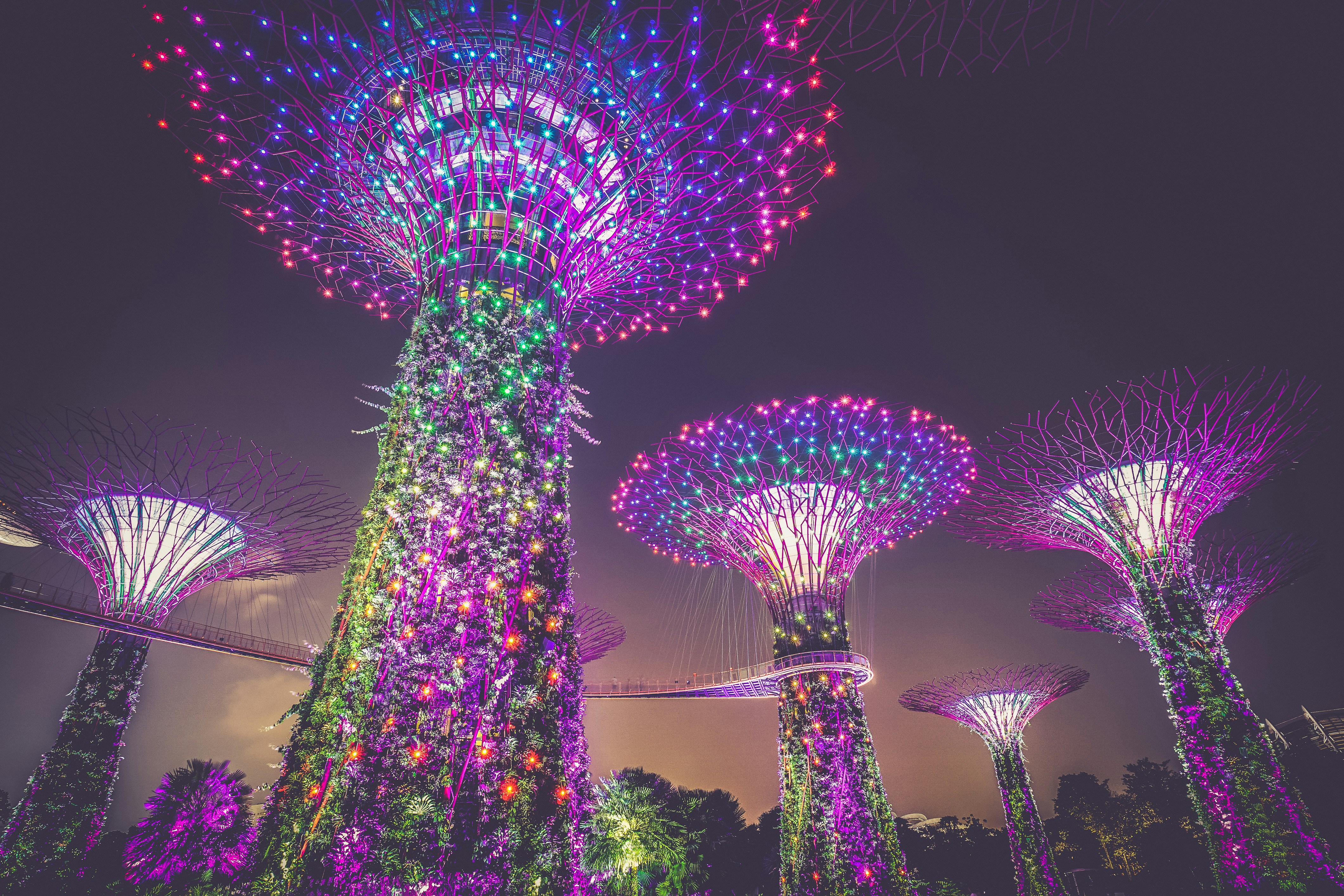
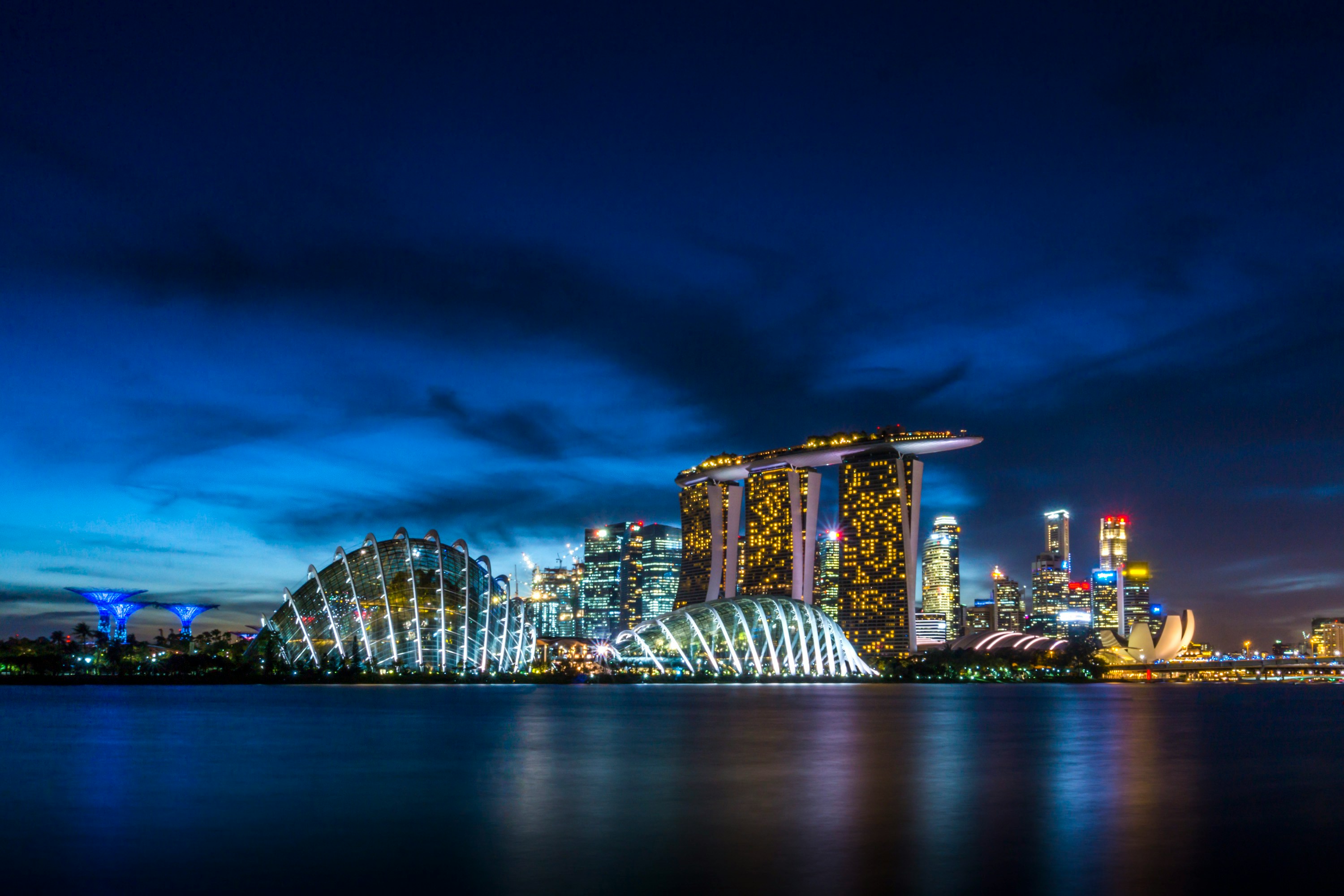
- Gardens by the Bay & Marina Bay: Gardens by the Bay — the 101-hectare national garden on reclaimed land in Marina Bay, with its 18 Supertrees (vertical gardens 25–50 m tall, their canopies covered in over 162,900 plants, illuminated at night in a light-and-sound show), the Cloud Forest conservatory (a mountain of tropical highland plants shrouded in mist, rising inside a glass dome), and the Marina Bay Sands hotel's iconic infinity pool at 200 m altitude overlooking the city skyline.
- Hawker centres & the food culture: Singapore's hawker centres — open-air collections of individual stalls each serving a single dish from a family tradition sometimes spanning three generations — are UNESCO-listed and represent the world's finest concentration of accessible, affordable great food. Lau Pa Sat (the Victorian cast-iron market), Maxwell Food Centre, and Old Airport Road Food Centre are the most celebrated; the dishes — Hainanese chicken rice, char kway teow, laksa, satay, chilli crab, roti prata, and bak kut teh — constitute a national food identity of extraordinary depth.
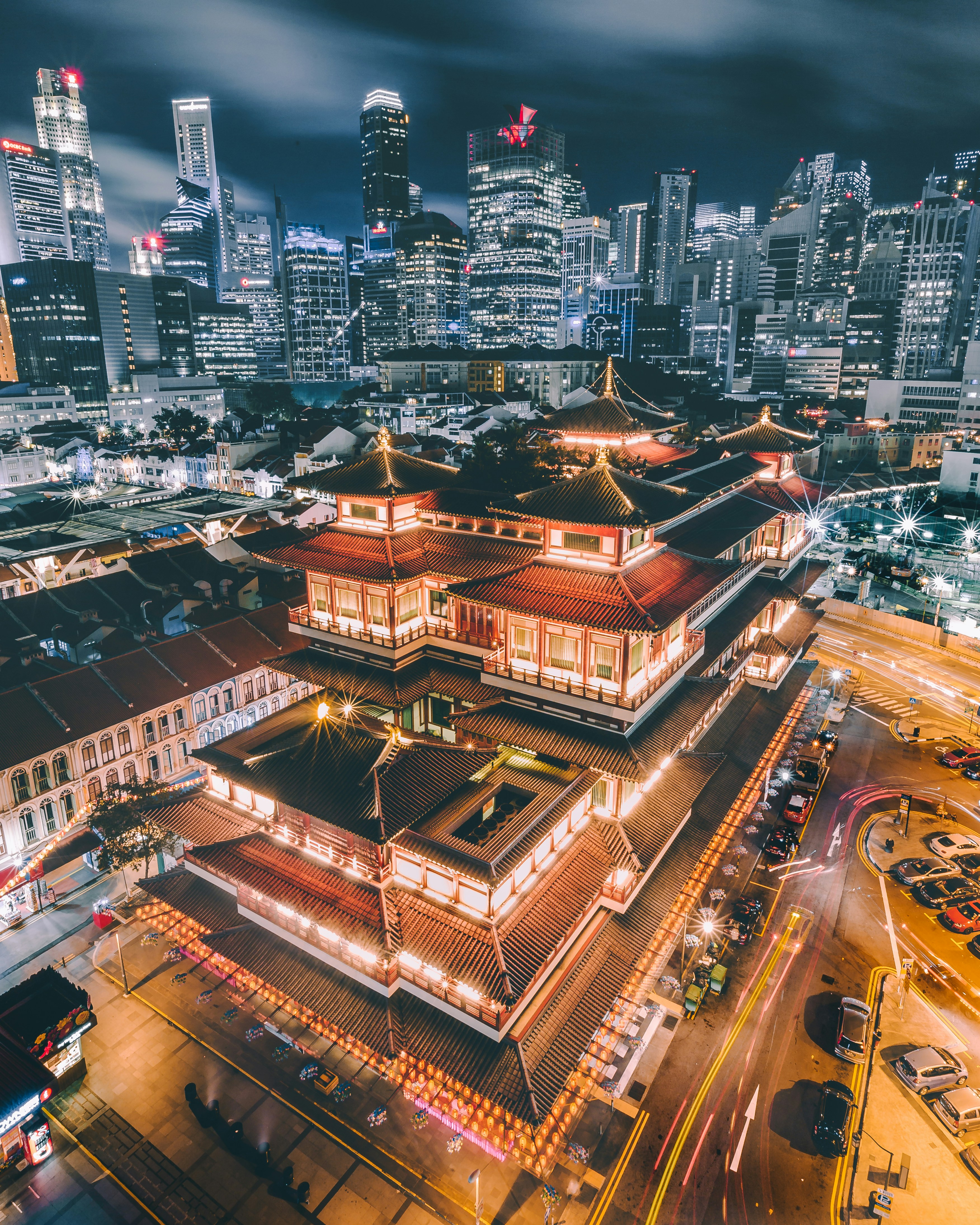
- Chinatown, Little India & Kampong Glam: The UNESCO-preserved ethnic enclaves — Chinatown's shophouses and the Sri Mariamman Temple, Little India's Mustafa Centre and Tekka Market and the Sri Veeramakaliamman Temple, Kampong Glam's Sultan Mosque and Arab Street and the Malay Heritage Centre — each preserve a living cultural world within 15 minutes of each other by MRT, making Singapore one of the world's most concentrated multicultural experiences.
- Night Safari & Sentosa: The Singapore Night Safari (the world's first nocturnal zoo, 35 hectares of naturalistic habitat where visitors move through on tram and walking trails past tigers, tapirs, leopards, and pangolins active in the dark) and Sentosa Island (the southern resort island with Universal Studios Singapore, the S.E.A. Aquarium, and cable car access from Mount Faber).
Cuisine
- Hainanese chicken rice — the national dish: Hainanese chicken rice — poached chicken (at its finest, barely cooked to a jade-smooth, silky texture that alarms the uninitiated) served over rice cooked in the chicken poaching broth and chicken fat, with ginger paste, chilli sauce, and dark soy on the side — is Singapore's unofficial national dish and the subject of passionate devotion. Tian Tian at Maxwell Food Centre and Boon Tong Kee are the pilgrimage destinations; the dish, brought to Singapore by Hainanese immigrants in the early 20th century, has been elevated here to a perfection found nowhere else.
- Chilli crab, laksa & char kway teow: Chilli crab (whole mud crab cooked in a tomato, egg, and chilli sauce of complex sweetness and heat, eaten with deep-fried mantou buns for sauce-sopping) is Singapore's most celebrated dish internationally. Laksa (a rich coconut curry broth with rice noodles, tofu puffs, fishcake, and prawns — the Katong version using short noodles eaten with only a spoon) and char kway teow (flat rice noodles wok-fried with Chinese sausage, cockles, and bean sprouts over the highest possible flame) are equally essential.
- Kopitiam culture — coffee and morning ritual: The kopitiam (coffee shop — from Hokkien kopi, coffee, and Malay tiam, shop) is Singapore's most democratic social institution — the traditional ones serving kopi (Robusta coffee beans roasted with butter and sugar, brewed through a cloth sock filter, served with sweetened condensed milk) and kaya toast (coconut jam and cold butter on charcoal-toasted bread with soft-boiled eggs dipped in dark soy and white pepper). The kopitiam breakfast, unchanged in 80 years, is the most Singaporean of all food experiences.
Traditions & Culture
- Multiracialism as state policy: Singapore's management of its multiethnic population (Chinese 74%, Malay 13%, Indian 9%) through deliberate state policy — ethnic integration in public housing, mother-tongue language education alongside English, the four official languages of equal status, the Presidential Council for Minority Rights — has produced a model of multiracial coexistence studied worldwide. The four major festivals (Chinese New Year, Hari Raya Aidilfitri, Deepavali, and Christmas) are all public holidays; their celebrations spill across ethnic boundaries in a genuinely shared national life.
- The Singapore Grip — discipline and ambition: Singapore's national character — described variously as kiasu (Hokkien: 'afraid to lose', the competitive anxiety that drives Singaporeans to queue for hours for the best chicken rice, choose the most prestigious school, and optimise every decision) and the relentless pursuit of excellence in public infrastructure — produces a city of extraordinary efficiency and a citizenry of formidable ambition. The national anxiety about Singapore's small size, lack of resources, and regional vulnerabilities drives a permanent sense of urgency that has been the engine of its success.
Climate
- Equatorial, hot and humid year-round: Singapore is hot and humid every day of the year (28–33°C, humidity 70–90%), with no real dry season — rain can fall at any time, though the northeast monsoon (November–January) and inter-monsoon periods (April, October) bring the heaviest rainfall. There is no 'best season' for Singapore — the equatorial climate is consistent year-round. Afternoon thunderstorms are frequent and dramatic; mornings are typically clear. The indoor-outdoor lifestyle of Singapore's hawker centres, gardens, and malls is designed for this climate.